

Dr. Sophie Brameyer
Akademische Rätin
Head of the Bioanalytics Core Facility, Radiation Protection Officer (Microbiology), Biological Safety Officer
Research
The mammalian gastrointestinal tract hosts diverse microbes, including Escherichia coli, an early colonizer of the infant gut and a lifelong member of the human microbiota. While non-pathogenic E. coli can support host health, pathogenic strains such as EHEC can cause severe disease, and the factors shaping non-pathogenic populations and heteroresistance remain poorly understood.
Our research group examines how abiotic and biotic stress conditions within the human gut impact bacterial antibiotic tolerance, with the aim of promoting the stability of non-pathogenic E. coli populations and enhancing antibiotic effectiveness against pathogenic E. coli strains. We utilize population-level techniques, such as minimal inhibitory concentration (MIC) determination and the minimal bactericidal concentration (MBC). Additionally, we use fluorescence microscopy to study stress response pathways and heteroresistance in individual bacteria exposed to antibiotics.
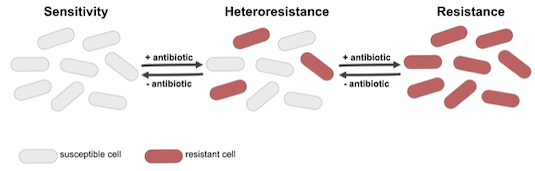
Heteroresistance scheme
My complete list of publications is available on Orcid