Systemic Neurobiology
Grothe-Lab

Grothe-Lab

© Carolin Bleese
Chair of Neurobiology (on leave of absence since 10/2025)
&
LMU Vice President for Natural and Life Sciences and Deputy President
Member of the Bavarian Academy of Sciences (BAdW)
Member of the German Academy of Sciences, Leopoldina
Phone (via Mrs Kiesl, Secretary for the Vice-Presidents)
Executive Board
Ludwig-Maximilians-Universität München
Georgenstraße 7
80779 München
Benedikt Grothe's primary scientific interest lies in achieving a mechanistic understanding of signal processing in the mammalian brain. His research group has analyzed the structure, physiology, function, evolution and development of the mammalian auditory systemtex. The group has published more than 150 scientific papers focusing on the precise processing of temporal and spatial auditory signal parameters, as well as their decoding and encoding principles along the ascending auditory pathway (from auditory brainstem to cortex).
Methods used in the laboratory include in vitro (acute brain slices) and in vivo electrophysiology, often in combination with neuropharmacology (micro-iontophoresis, laser uncaging, etc.), optogenetics, comparative anatomy, immunohistochemistry, in vivo Ca²⁺ imaging, modelling, animal and human psychophysics.
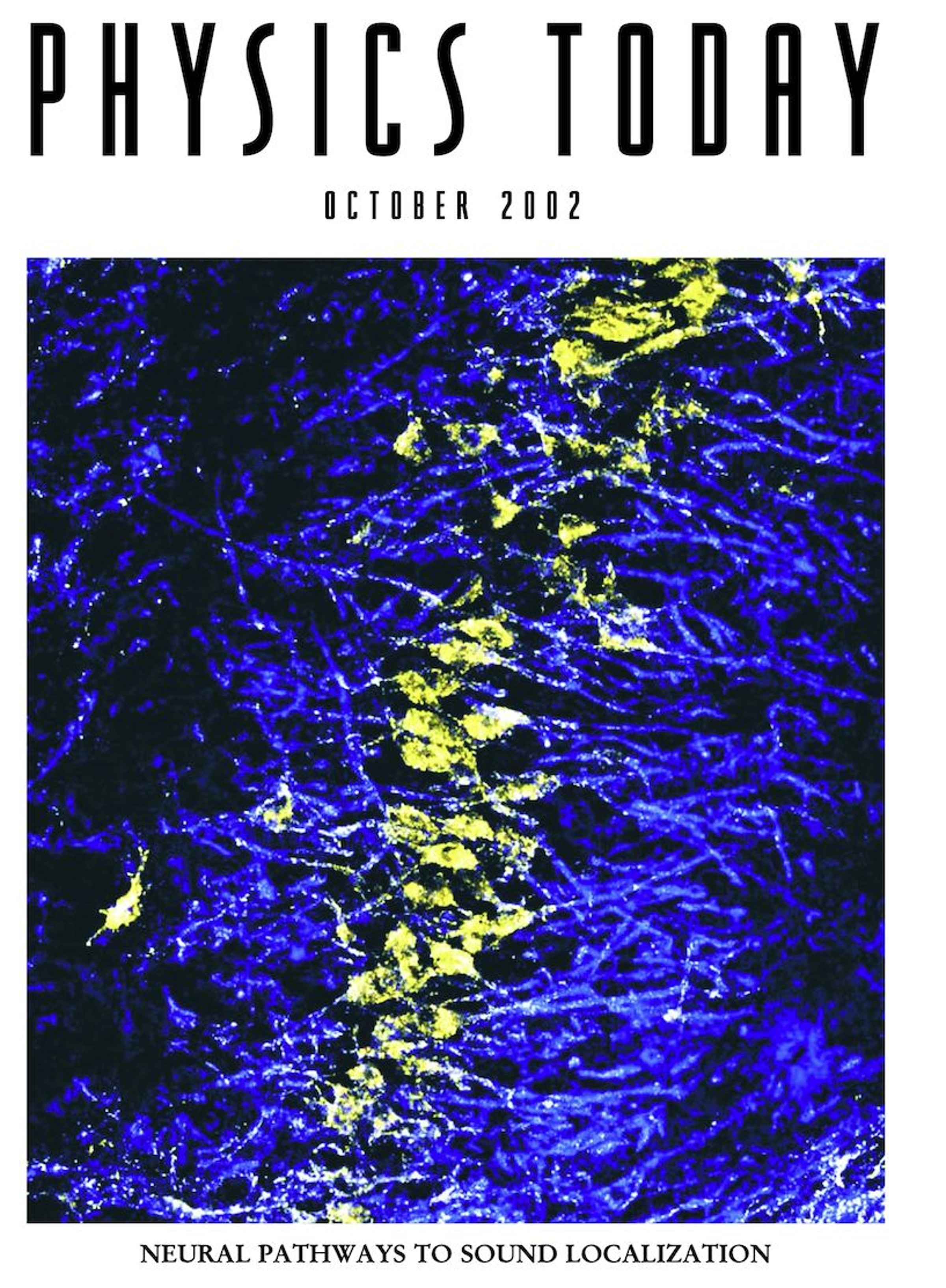
Arrangement of functional inputs to the medial superior olive (MSO), the structure that encodes differences of the arrival of sounds at the two ears with microsecond precision. MSO neurons are labeled in blue (MAP2), glycinergic (inhibitory) inputs are shown in yellow (glycine receptor antibody staining). Scale bar: 100 μm.
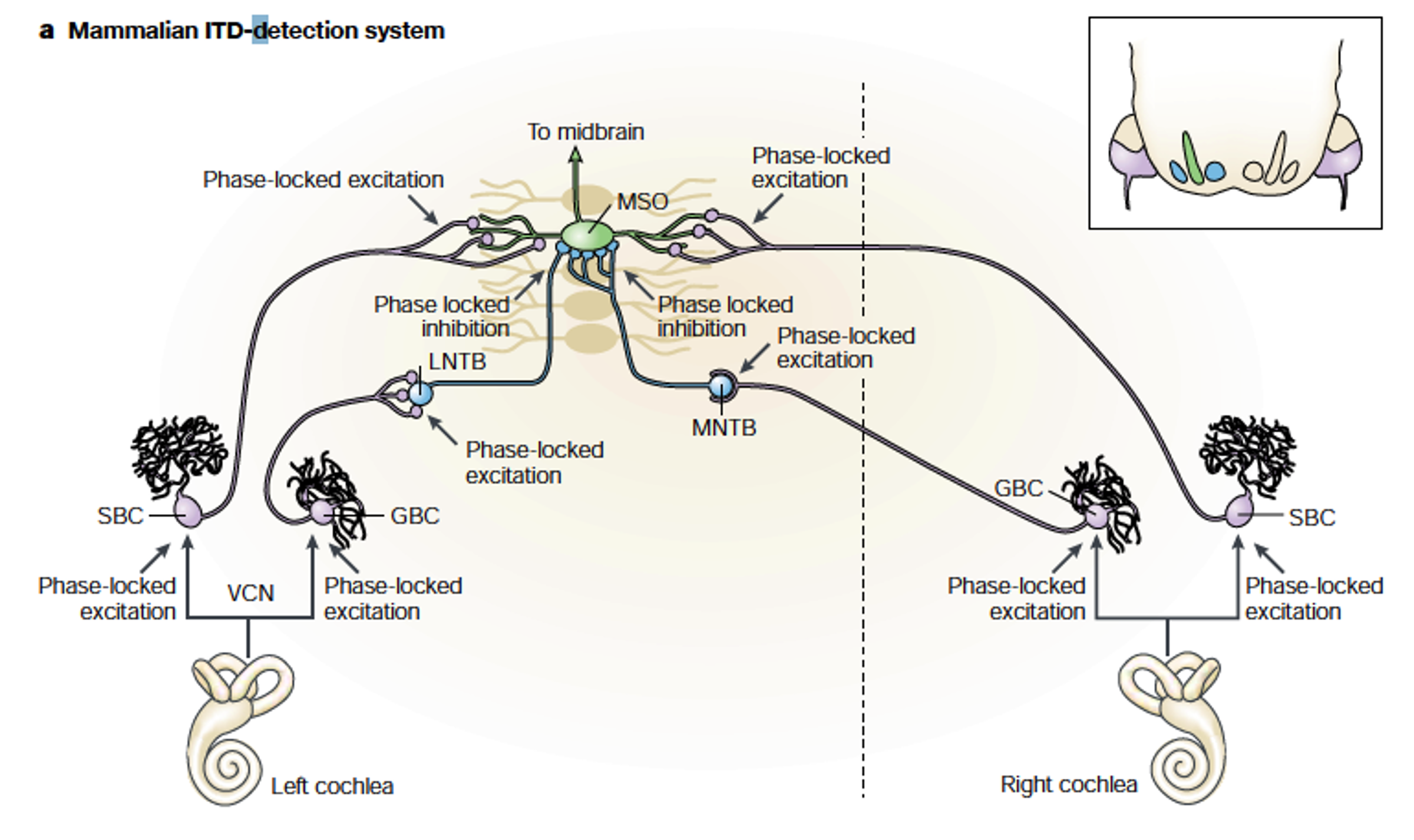
The interaural time difference (ITD)-encoding systems in mammals: The mammalian ITD encoder is the medial superior olive (MSO), an auditory brainstem structure (inset). MSO neurons are bipolar and their somata are arranged in one parasagittal plane. Excitatory projections originate from the left and right cochlea. Auditory nerve-fibre discharges time-lock to the stimulus onset or phase-lock to ongoing pure tones up to about 2 kHz. They excite spherical and globular bushy cells (SBC and GBC, respectively) in the ventral cochlear nuclei (VCN). SBCs and GBCs also provide phase-locked excitation to their targets: SBCs project to the MSO on both sides, GBC cells to the contralateral medial nucleus of the trapezoid body (MNTB) and the ipsilateral lateral nucleus of the trapezoid body (LNTB). The inputs to MNTB and LNTB are specialized to preserve temporal information: the MNTB is driven by a gigantic synapse, the calyx of Held. MNTB and LNTB neurons provide phase-locked, glycinergic, hyperpolarizing inhibition to the ipsilateral MSO. MSO neurons extract the ITD from a comparison of their four inputs and project to higher auditory centres. The well-timed inhibition is crucial for adjusting the ITD sensitivity of MSO cells to the physiological relevant range of ITDs.
Benedikt Grothe studied biology and psychology at Ludwig Maximilians University of Munich (LMU). After completing his neuroscience doctorate, he became a curator at the Museum Mensch und Natur, a natural history museum in Munich. He then moved to the lab of George Pollak at University of Texas at Austin and subsequently to the lab of Dan H. Sanes at the Center for Neural Sciences at New York University (NYU) as a postdoctoral researcher. From 1994 to 1998, he was an assistant professor at the Zoological Institute (LMU). From 1999 to 2003, he led an independent research group at the Max Planck Institute for Neurobiology in Martinsried. Since 2003 he has been Chair of Neurobiology at the Faculty of Biology at LMU. He founded the Munich Bernstein Center for Computational Neurosciences (BCCN) and the Bavarian Elite Program M.Sc. in Neurosciences. He also established the Munich Center for Neuroscience – Brain & Mind (MCNLMU) and the Graduate School for Systems Neuroscience (GSNLMU), the latter of which was founded via the German Excellence Initiative. He initiated and headed the DFG Collaborative Research Centre CRC870, 'Assembly and Function of Neuronal Circuits', from 2010 to 2022. He was Max Planck Fellow (2015-2025) and is a member of both the Bavarian Academy of Sciences (BAdW) and the German Academy of Sciences Leopoldina.
Benedikt Grothe served as Director of the LMU Department of Biology II, as well as Vice-Dean and Dean of the LMU Faculty of Biology.
In recognition of his outstanding contributions to neuroscience, he was awarded the Federal Cross of Merit in 2010.
Since October 2025, he has been on leave from his position as Chair of Neurobiology, acting as elected Vice President for Natural and Life Sciences and Deputy President of LMU.
Nabel AL, Teich L, Wohlfrom H, Alexandrova O, Heß M, Pecka M, & Grothe B (2024) Development of Myelination Patterns for Fast and Temporally Precise Auditory Signalling. GLIA 72:794-808
Ford MC, Alexandrova O, Cossell L, Stange-Marten A, Sinclair J, Kopp-Scheinpflug C,
Pecka M, Attwell D, & Grothe B (2015) Tuning of Ranvier node and internode properties in myelinated axons to adjust action potential timing. Nature Communic 25;6:8073
Grothe B, Pecka M, McAlpine D (2010) Mechanisms of sound localization in mammals. Physiol Rev 90:983-1012
Grothe B (2003) New roles for synaptic inhibition in sound localization. Nature Rev Neurosci 4: 540-550
Brand A, Behrend O, Marquardt T, McAlpine D, & Grothe B (2002) Precise inhibition is essential for microsec-ond interaural time difference coding. Nature 417: 543-547
Kapfer C, Seidl AH, Schweizer H, Grothe B (2002) Experience-dependent refinement of inhibi-tory inputs to auditory coincidence-detector neurons. Nature Neurosci 5: 247-253
Grothe B, Sanes DH (1994) Synaptic inhibition influences the temporal coding properties of medial superior olivary neurons: an in vitro study. J Neurosci 14:1701-9.
Grothe B, Vater M, Casseday JH, Covey E (1992) Monaural interaction of excitation and inhibition in the medial superior olive of the mustached bat: an adaptation for biosonar. Proc Nat Acad Sci USA 89: 5108-5112