Neurophysiology Lab
Kopp-Scheinpflug Lab

Kopp-Scheinpflug Lab

© STARUP
We explore how sensory experiences—especially sounds—shape neural activity in real time through the lens of neurophysiology. Our focus is on how neuromodulators, acting as context-dependent chemical messengers, influence synaptic processing and control the excitability of neurons and entire circuits. Using a combination of neurophysiological, anatomical, and behavioral techniques, we uncover the dynamic mechanisms that allow perception, support brain adaptability, and maintain function. Understanding these processes helps us reveal the neural basis of functional changes and identify new avenues for treating neurological disorders.
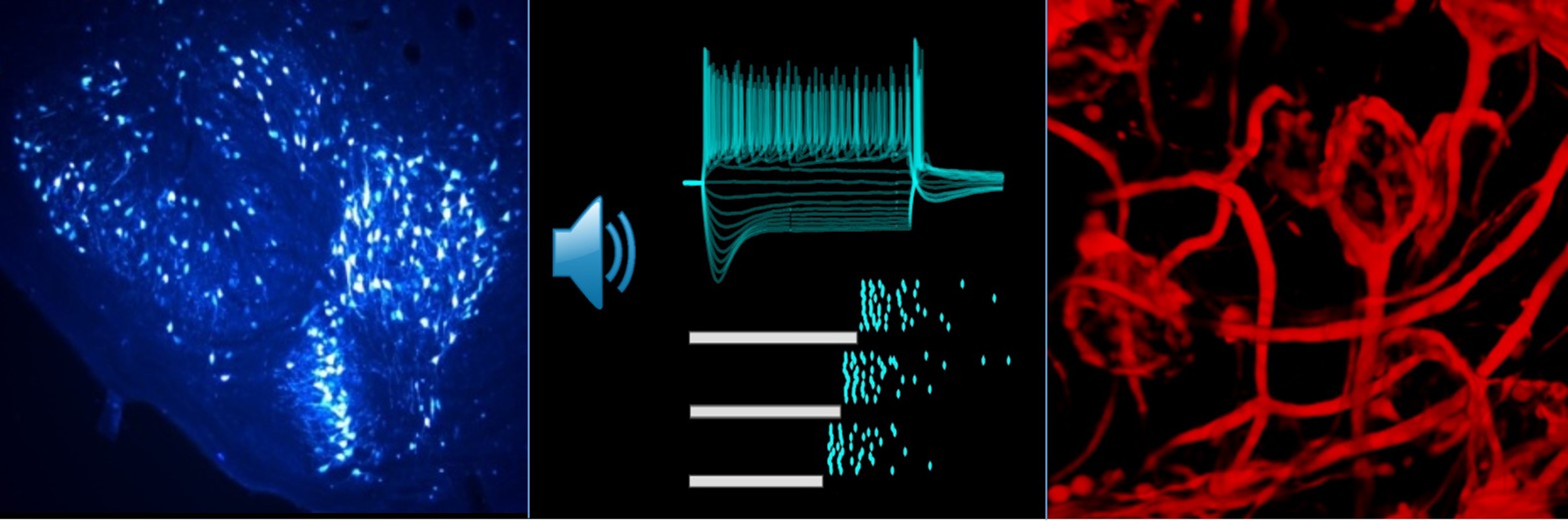
Tuning the Brain’s Wiring with Sound.
Our brains adapt the speed of nerve signals through myelin, the insulating sheath around axons. Sound experience shapes myelin locally, fine-tuning neural circuits for precise timing. This adaptive myelination is key to perception, learning, and maintaining healthy auditory function throughout life.
Encoding the End of Sound.
Specialized neurons in the brainstem detect the end of sounds, a process essential for perceiving speech and vocal patterns. Inhibitory inputs trigger precise spikes at sound offset, and the circuit adapts rapidly during development and after traumatic noise exposure to maintain accurate timing. This reveals how the auditory system encodes sound offset with remarkable precision and resilience.
Linking Ion Channels to Hearing and Movement.
Mutations in the Kv3.3 potassium channel disrupt high-frequency firing in auditory and cerebellar neurons, leading to sound-localization deficits and motor impairments in SCA13 in humans and mice. Our CRISPR-Cas9 mouse model shows how these mutations broaden action potentials, impair neural circuit timing, and trigger Purkinje neuron degeneration, revealing the mechanisms behind both sensory and motor deficits.
Selected Publications:
| Name | Title | Tel | Responsibility | |
|---|---|---|---|---|
| Kopp-Scheinpflug , Conny | PD Dr. | cks@bio.lmu.de | +49 89 2180 74364 | Principal Investigator |
| Küçüközcan, Arda | arda.kuecuekoezcan@campus.lmu.de | Master-Student |