Neural Mechanisms of Vision, Neuroinformatics
Wachtler Lab

Wachtler Lab

While sensory signals under natural viewing conditions are highly variable, the brain provides us with stable percepts of our visual environment. We are interested in how the brain efficiently processes the sensory input and achieves invariant representations. We use methods from neurophysiology, psychophysics, and computational modeling, to study the neural principles of processing and coding in the visual system and how they relate to the properties of the sensory environment and to perceptual phenomena.
Color Vision
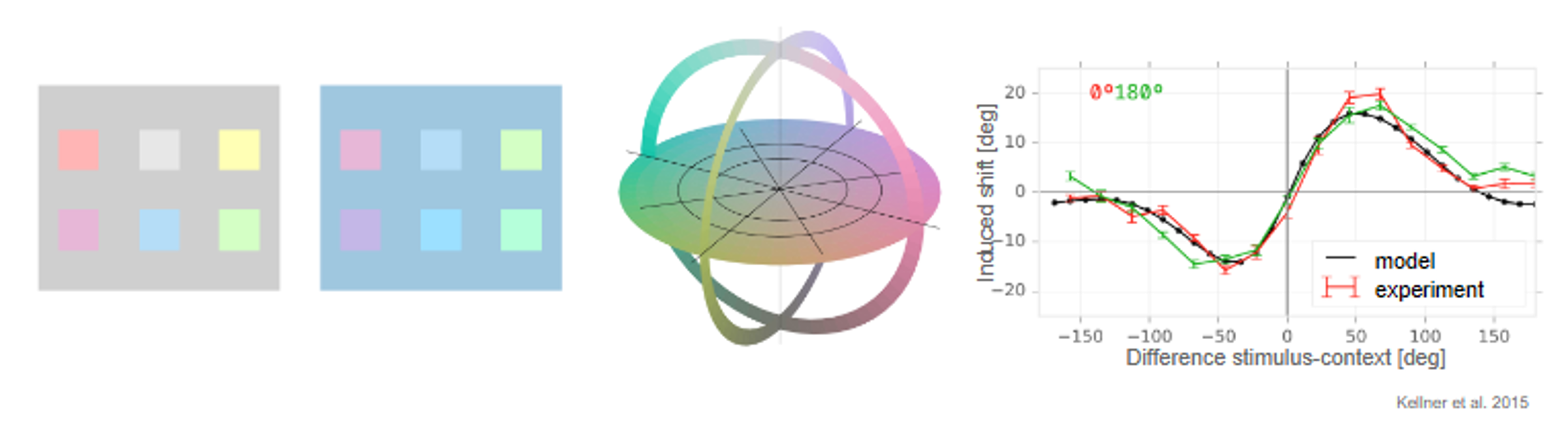
Color is an important visual cue for object recognition and orientation. However, the surface color of an object has to be infered by the brain taking into account the visual context such as the illuminant. We investigate efficient coding mechanisms for color and how they enable contextual computations to achieve stable color perception.
Vision and Eye movements
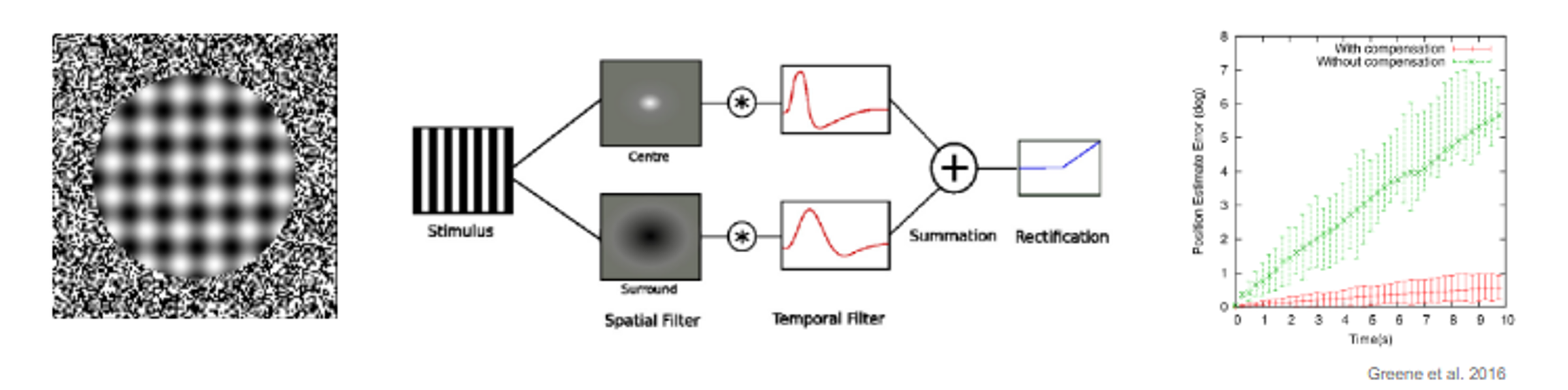
Eye movements disrupt the spatiotemporal continuity of neural representations at early stages of the visual system. Nevertheless our brain provides us with a stable percept of our visual environment. We investigate neural mechanisms for compensating the effects of eye movements on the visual signals to achieve invariant representations.
Advances in technology and methodology lead to growing amounts of increasingly complex neuroscience data. Efficient management of such data has become a challenge.
At the German Neuroinformatics Node we are developing infrastructure to support efficient organization, storage, analysis, and sharing of neurophysiology data, so that the researcher can focus on the scientific questions rather than on problems of data management. Tools and services include formats for storing and integrating data and metadata, and services for version controlled organization, sharing, and publication of research data.
Su Y, Shi Z, Wachtler T (2024) A Bayesian observer model reveals a prior for natural daylights in hue perception. Vision Research 220:108406. https://doi.org/10.1016/j.visres.2024.108406
Vattuone N, Wachtler T, Samengo I (2021) Perceptual spaces and their symmetries: The geometry of color space. Mathematical Neuroscience and Applications 1:7108. https://doi.org/10.46298/mna.7108
Denker M, Grün S, Wachtler T, Scherberger H (2021) Reproducibility and efficiency in handling complex neurophysiological data. Neuroforum 27(1):27-34. https://doi.org/10.1515/nf-2020-0041
Greene G, Gollisch T, Wachtler T (2016) Non-linear retinal processing supports invariance during fixational eye movements. Vision Research 118:158-170. https://doi.org/10.1016/j.visres.2015.10.012
Klauke S, Wachtler T (2015) “Tilt” in color space: Hue changes induced by chromatic surrounds. Journal of Vision 15(13):17. https://doi.org/10.1167/15.13.17
| Name | Title | Tel | Room | Responsibility | |
|---|---|---|---|---|---|
| Wachtler, Thomas | Prof. Dr. | wachtler@bio.lmu.de | +49 89 2180 74810 | B01.055 | Principal Investigator |
| Gupta, Reema | reema.gupta@bio.lmu.de | +49 89 2180 74812 | B01.063 | PhD Student | |
| Schrader, Felix | felix.schrader@campus.lmu.de | +49 89 2180 74137 | B01.061 | PhD Student |
We are inviting applications from motivated Bachelor and Master students to join us for lab rotations and thesis work. Programming skills are necessary. Apply by sending an email to Thomas Wachtler.